DermCheckHAUTKREBS-SCREENING
How It Works
AI-Powered Skin Cancer Early Detection

Your skin deserves the best care

Photograph suspicious moles with your smartphone. Our AI analyzes the risk in seconds — if needed, a board-certified dermatologist personally reviews your image.

How It Works
GDPR-compliant
Board-certified physicians
Results in 30 sec.

Early skin cancer detection with AI — fast, anonymous, free

Skin cancer is one of the most common cancers worldwide, with millions of new cases diagnosed each year — and rates are rising. However, when caught early, melanoma, basal cell carcinoma and squamous cell carcinoma are curable in over 95% of cases. The key is recognising suspicious moles in time.

DermCheck combines clinically validated AI models (Med-Foundation on RunPod) with Claude Vision to assess your mole in seconds using the ABCDE rule. If anything looks suspicious, you can request an optional second opinion from a certified dermatologist — within 24 hours, GDPR-compliant and without an in-person visit.

The AI analysis is free, anonymous and does not replace a medical diagnosis. It helps you reach the right decision faster: whether to perform a self-examination, schedule a skin cancer screening with your GP, or seek a professional dermatoscopy.

→ DermCheck Blog·→ Directory·→ Our Team
Simple & fast

How It Works

Professional skin analysis in 3 simple steps

1
Scan

Take a photo

Photograph the suspicious skin area with your smartphone camera. Our app provides real-time feedback for optimal image quality.

Automatic sharpness and lighting check
2
KI-Analyse
Asymmetry
85%
Border
72%
Color
45%
Diameter
30%
Evolution
20%
Low Risk — 92%

AI analysis

Our trained AI analyzes your image in seconds using the ABCDE criteria and provides an immediate risk assessment.

Based on 100,000+ analyzed images
3
Dr. WeberDr. Sarah Weber Fachärztin Dermatologie
Befund geprüft
ABCDE bestätigt
Empfehlung erstellt
24h

Physician review

Optional: A board-certified dermatologist personally reviews your image and provides a well-founded medical assessment.

Response within 24 hours
Visual Guide

Examples: Harmless vs. Dangerous

Learn the difference between harmless and suspicious moles

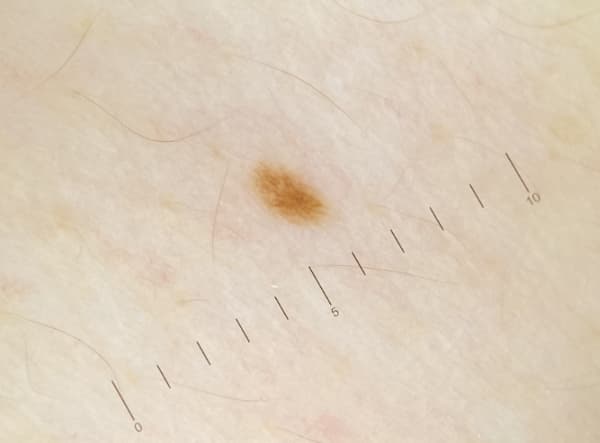
Harmless

Normal mole

Uniform color, symmetrical, clear borders, smaller than 6mm. No cause for concern.

  • Symmetrical
  • Uniform color
  • Smooth borders
  • < 6mm diameter
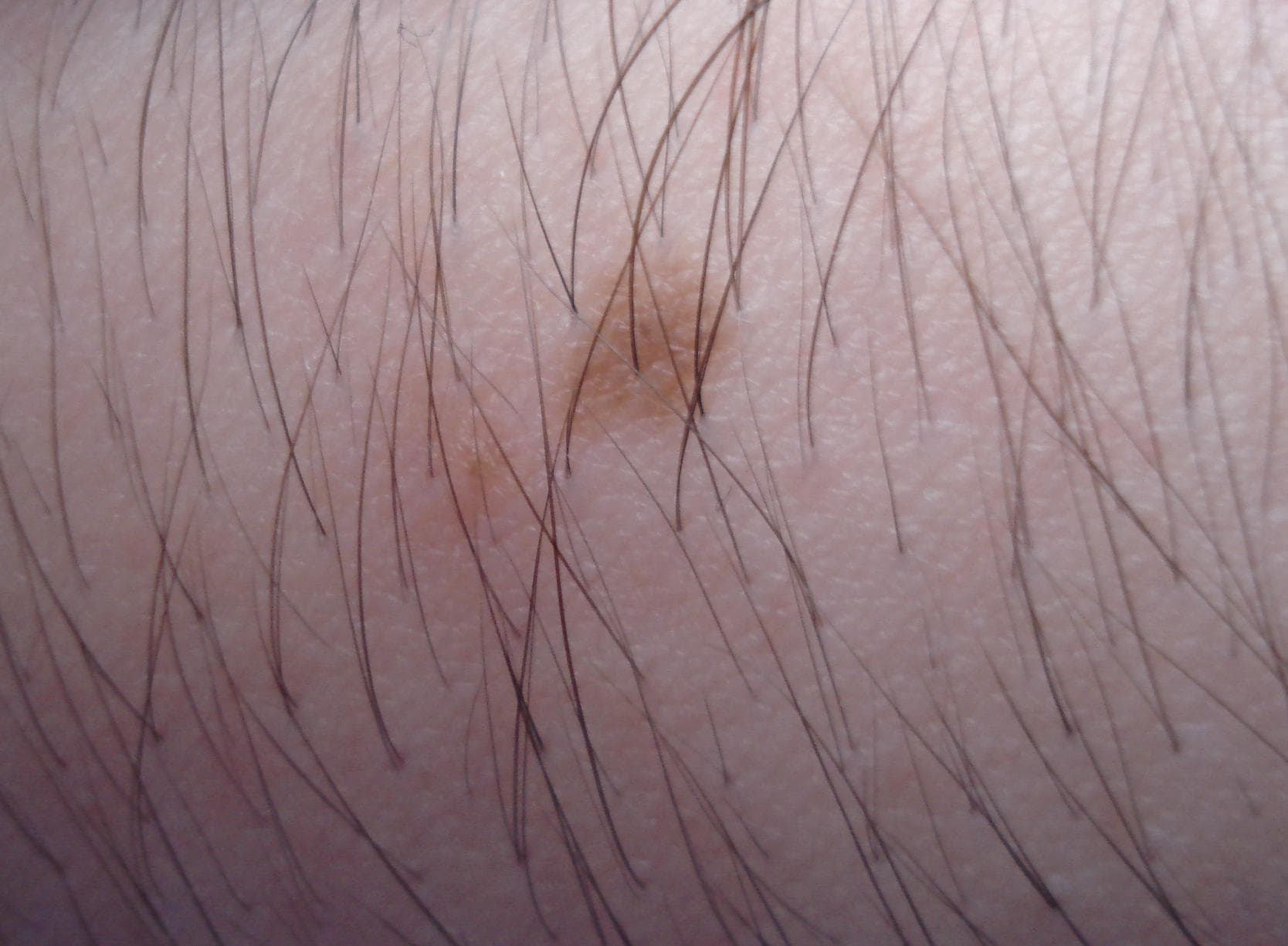
Suspicious

Irregular mole

Irregular borders, multiple colors, asymmetric. Should be examined by a physician.
  • Asymmetric
  • Irregular borders
  • Different color shades
  • Change over time
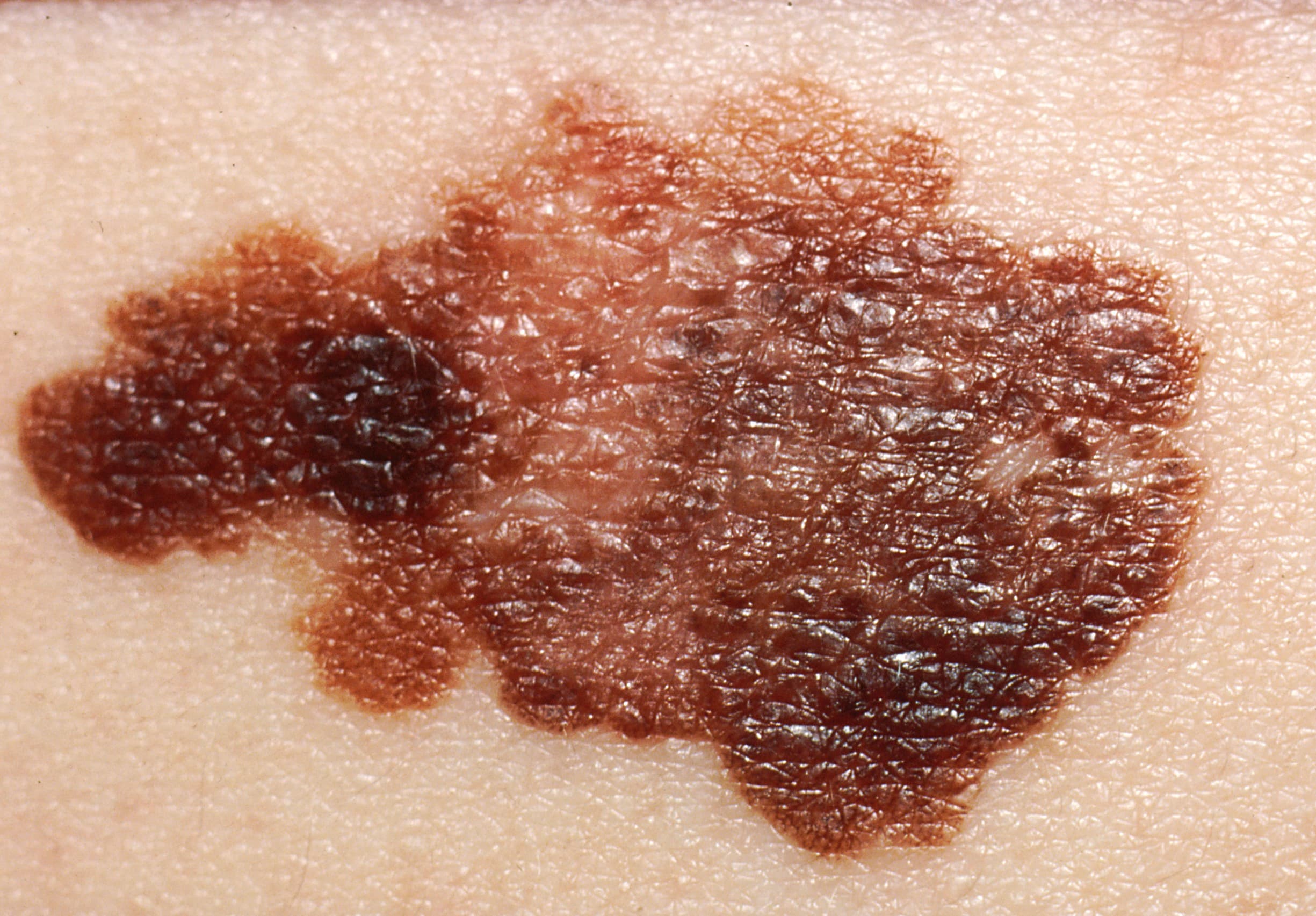
Dangerous

Possible melanoma

Highly irregular, multi-colored, blurry borders. Immediate medical examination recommended.

  • Highly asymmetric
  • Blurry borders
  • Black/red mixed
  • > 6mm diameter
Medical Knowledge

The ABCDE Rule

How to identify suspicious skin changes yourself

A

Asymmetry

A mole that is not symmetrical — one half looks different from the other.

Asymmetrical moles are suspicious.
Asymmetric melanoma — the left side is noticeably thicker than the right

Asymmetric melanoma — the left side is noticeably thicker than the right

Source: NCI / Skin Cancer Foundation (Public Domain)
B

Border

Blurry, ragged, or irregular edges instead of smooth, clearly defined borders.

Watch for jagged or blurry edges.
Melanoma with irregular, ragged borders

Melanoma with irregular, ragged borders

Source: NCI / Skin Cancer Foundation (Public Domain)
C

Color

Different shades within a mole: brown, black, red, white, or blue.

Multi-colored moles are a warning sign.
Melanoma with different color shades: brown, black, tan

Melanoma with different color shades: brown, black, tan

Source: NCI / Skin Cancer Foundation (Public Domain)
D

Diameter

Moles larger than 6mm (pencil eraser) are more suspicious.

Larger than 6mm = have it examined by a physician.
Melanoma with significant size change (> 6mm diameter)

Melanoma with significant size change (> 6mm diameter)

Source: NCI / Skin Cancer Foundation (Public Domain)
E

Evolution

Any change in size, shape, color, or symptoms (itching, bleeding) is an alarm signal.

Always take changes seriously.
Dysplastic nevus that evolved into a melanoma over 18 months

Dysplastic nevus that evolved into a melanoma over 18 months

Source: National Cancer Institute (Public Domain)
Live Demo

How Dermatologists Review

Swipe to experience the doctor review process

Dermatologen-Portal
Heute: 0/3 Reviews€0.00
Case 1
Image 1 of 3
Patient #1247
Rücken, links
Alter: 34 J.
KI-Voranalyse
Low Risk
Asymmetry
15%
Border
22%
Color
18%
Diameter
20%
Evolution
10%
KI-Analyse dient als Voreinschätzung. Ihre fachärztliche Bewertung ist entscheidend.
Our Team

Board-Certified Dermatologists

Experienced specialists personally review your skin images

Dr. med. Sarah Weber

Dr. med. Sarah Weber

Board-Certified Dermatologist

Dermoscopy & Digital Image Analysis

12 years of experience

Specialist in early melanoma detection through digital dermoscopy. Senior attending physician at the Munich Skin Cancer Center.

Dr. med. Michael Richter

Dr. med. Michael Richter

Board-Certified Dermato-Oncologist

Skin Tumor Diagnostics & Therapy

15 years of experience

Expert in the diagnosis and treatment of skin tumors. Heads the department of digital skin screening.

Dr. med. Lisa Hoffmann

Dr. med. Lisa Hoffmann

Board-Certified Dermatologist

Preventive Dermatology

10 years of experience

Pioneer of teledermatology in Germany. Specialized in preventive skin cancer screening and digital patient care.

Quality Assurance

All physicians are licensed in Germany and members of the DDG. Your data is processed in compliance with GDPR.

Testimonials

What Our Users Say

“I had a suspicious mole and was unsure. DermCheck gave me an immediate assessment and referred me to a doctor. It was actually an early stage!”

— Anna M.

“Fast, simple, and professional. The AI analysis was ready within seconds, and the doctor responded within 24 hours.”

— Thomas K.

“Finally an app that is medically credible. No scare tactics, just well-founded assessments. I recommended it to my entire family.”

— Sabine R.

Facts & Figures

Skin Cancer in Germany

Skin cancer is the most common type of cancer worldwide — but early detection saves lives

0+
New cases per year in Germany
Including basal cell and squamous cell carcinoma
~0
Melanoma cases per year
The most dangerous form of skin cancer
+50%
Increase over the past 20 years
Prevention is more important than ever

5-Year Survival Rate for Melanoma

Early detection (Stage I)0%
Middle stage (II–III)62%
Late detection (Stage IV)0%
Early detection increases the chance of survival by 6 times
Prevention works

Prevention Saves Lives

Regular screening and sun protection drastically reduce the risk of skin cancer

Risk Reduction Through Prevention

80%Reduction
UV Protection

Sunscreen SPF 50+, protective clothing & avoid midday sun

50%Reduction
Screening

Regular skin cancer screening from age 35 (covered by insurance)

63%Reduction
Self-examination

Monthly self-check using the ABCDE rule

How to Protect Yourself

Apply sunscreen SPF 50+ daily
Even on cloudy days — 80% of UV rays penetrate clouds
Avoid midday sun (11 AM – 3 PM)
UV exposure is highest during this time
Monthly self-examination
Check your moles using the ABCDE rule
Skin cancer screening every 2 years
Covered by insurance from age 35 — take advantage of it!
Wear protective clothing & a hat
UV-protective clothing offers the best protection
Avoid tanning beds completely
Increases melanoma risk by up to 75%
90% of all skin cancer cases are caused by UV radiation — and therefore preventable.
Research & Data

Scientifically Proven

Current studies show: early detection and prevention are the most effective weapons against skin cancer

Melanoma Incidence in Germany

New cases per 100,000 population (age-standardized)

2520151050
199019952000200520102015201820202024
Dtsch Arztebl Int 2024 — Registry-Based Time Series Study

Stage Distribution at Diagnosis

Proportion of melanomas by UICC stage at initial diagnosis

67%Stadium I
Stage I — 67%99% survival rate
Stage II — 18%75% survival rate
Stage III — 10%~60% survival rate
Stage IV — 5%35% survival rate
Robert Koch Institut — Zentrum für Krebsregisterdaten

Effectiveness of Preventive Measures

Risk reduction through various protective measures (based on meta-analyses)

Daily sunscreen SPF 50+
50% Reduktion
Skin Cancer Foundation
Sunburn avoidance
80% Reduktion
American Cancer Society
Skin cancer screening (from age 35)
13,8% Reduktion
JDDG Microsimulation 2025
Avoiding tanning beds
75% Reduktion
WHO/IARC
Protective clothing + shade
73% Reduktion
Epidemiology of Melanoma, PMC
Self-examination (monthly)
63% Reduktion
AAD Guidelines
PMC — State of the Science on Prevention and Screening

Sources & Studies

Longer Survival From Melanoma in Germany — Dtsch Arztebl Int 2024Evaluation of Skin Cancer Screening in Germany — JDDG Microsimulation 2025State of the Science on Prevention and Screening — CA Cancer J Clin 2016Robert Koch Institut — Zentrum für KrebsregisterdatenEpidemiology of Melanoma — PMC 2021SEER Cancer Stat Facts: Melanoma of the Skin — NCI
Annual Plans

Regular Skin Screening

Annual skin cancer prevention as a subscription — we remind you when your next checkup is due

AI Analysis

0€
  • Instant risk assessment
  • ABCDE rule analysis
  • Results in 30 seconds
Try for free

Basic Plan

19,99€/ year

equals €1.67/month

Up to 8 images per year
  • AI analysis + doctor review
  • Response within 24 hours
  • Annual checkup reminder
  • Written action recommendation
Start subscription
RECOMMENDED

Premium Plan

39,99€/ year

equals €3.33/month

Up to 30 images per year
  • AI analysis + express doctor review
  • Response within 6 hours
  • Annual checkup reminder
  • Detailed findings report
  • Personal follow-up consultation
Start subscription

Annual reminder: We automatically notify you when your next skin check is due — for regular prevention and early detection.

FAQ

Frequently Asked Questions

Answers about AI skin analysis, accuracy and data protection

Our pipeline combines a medical foundation model (which segments the mole and classifies it into 8 classes) with Claude Vision (ABCDE + 7-point checklist). In internal tests on the ISIC and HAM10000 datasets, sensitivity for malignant lesions exceeds 90%. For uncertain cases, we actively recommend a second opinion from a doctor.
No. DermCheck is not a medical device and does not replace a medical diagnosis. We provide a risk screening that helps you identify early on whether a mole might be suspicious. For any concerning finding, please consult a dermatologist.
The AI skin analysis is free to use and does not require an account. Optionally, we offer an assessment by a certified dermatologist for EUR 19.90 (Standard, 24h) or EUR 39.90 (Express, 6h).
If you create an account, we store your images encrypted on servers in the EU (GDPR-compliant). Anonymous scans are automatically deleted after 30 days. Images are never shared with third parties — unless you actively order a dermatologist assessment.
The ABCDE rule is the most important clinical standard for early detection of melanoma: A = Asymmetry, B = Border, C = Color, D = Diameter over 6 mm, E = Evolution (change). Our AI checks each of these criteria and outputs a score from 0–2 per letter.
We train and evaluate our models on data covering all Fitzpatrick skin types (I–VI). In your profile you can indicate your skin type, which measurably improves the analysis for darker skin tones. For very dark skin, we always additionally recommend a medical examination.
Daylight, sharp focus, the mole fills at least a quarter of the image, no flash, as perpendicular as possible. DermCheck automatically checks the image quality and gives you direct feedback (sharpness, exposure, framing).
Licensed dermatologists from Germany, Austria and Switzerland — all verified via their medical licence number. They only see the image and your AI report, no contact details. You receive their assessment as BENIGN, SUSPICIOUS or UNSURE along with a comment.
Currently a Progressive Web App (PWA): you open skincancercheckup.com in your browser, can add it to your home screen and use it like a native app — without any app store download. Works on iOS, Android and desktop.
The AI analysis takes about 3–8 seconds. The dermatologist assessment arrives within 24 hours (Standard) or 6 hours (Express). You will receive an email notification as soon as the result is ready.

Ready for Your Skin Analysis?

The initial AI analysis is free. Professional physician review from €19.90.

Free AI analysis Results in 30 sec. GDPR-compliant
DermCheckHAUTKREBS-SCREENING

Medical Disclaimer: DermCheck is not a substitute for a medical diagnosis. The AI analysis is intended solely as an initial assessment.

Scan nowHow It WorksOur Team
Legal NoticePrivacy PolicyTerms & ConditionsDermCheck Blog
DirectoryNew YorkChicagoHoustonDallasPhoenixLos AngelesSan FranciscoMiami

© 2026 DermCheck. All rights reserved. All data processed in compliance with GDPR.