Melanoma Early Detection: Self-Exam, Dermoscopy & AI
Learn all about skin cancer early detection – from self-examination and dermoscopy to innovative AI solutions like DermCheck for your skin health.
Pubblicato il 2026-03-16 · DermCheck Editorial
Questo articolo è stato creato con l'ausilio dell'intelligenza artificiale.
The Importance of Early Detection: Why Malignant Melanoma Demands Our Attention
As leading experts in skin health at DermCheck, our primary concern is to raise awareness for the early detection of skin cancer, especially malignant melanoma. Malignant melanoma, often known as "black skin cancer," is rarer than "white skin cancer" (basal cell and squamous cell carcinoma), but significantly more dangerous. Its ability to metastasize early makes it the leading cause of death from skin tumors. This highlights why a timely diagnosis is not just important, but life-saving.
In this article, we will illuminate the fundamental pillars of melanoma early detection: individual responsibility through self-skin examination, professional examination using dermoscopy, and the promising advancements in AI technology that complement and revolutionize these methods. We base our insights on the latest studies, medical guidelines, and epidemiological data to provide you with a comprehensive and evidence-based understanding. Our goal is to equip you with the knowledge and tools necessary for proactive skin cancer prevention.
Alarming Figures: Epidemiology and Survival Rates of Melanoma
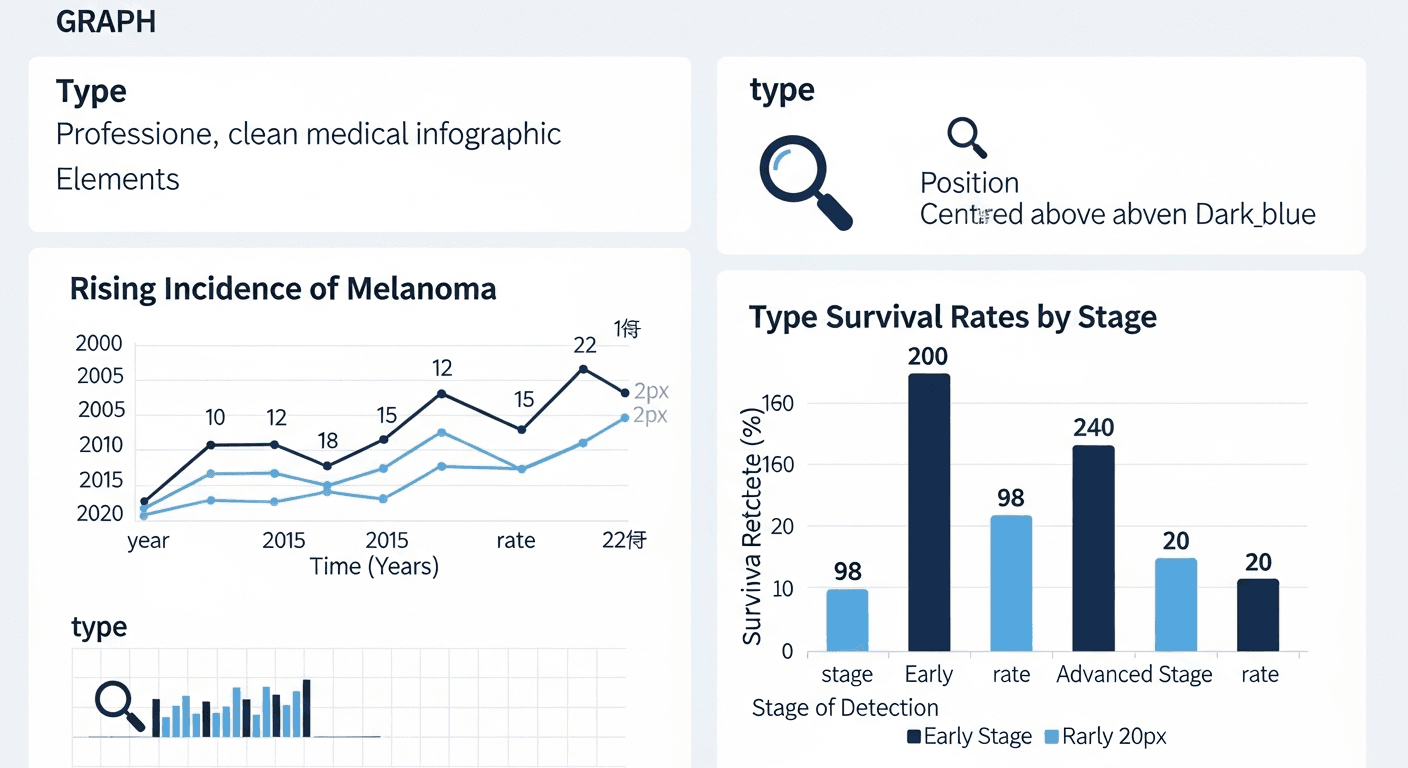
The incidence of malignant melanoma is steadily increasing worldwide and in Germany, underscoring the urgency of early detection. It is notable that melanoma is the second most common cancer in people aged 15 to 29. Incidence has risen significantly: In the US, an estimated 234,680 new cases are projected for 2026, with over 112,000 being invasive. This represents a 46.6 percent increase over the last decade (2016–2026). In Germany, approximately 27,430 people were newly diagnosed with malignant melanoma in 2023. The median age at diagnosis was 64 for women and 69 for men.
Prevalence figures also show high rates of affected individuals: In 2023, over 232,000 people lived with melanoma in Germany. The good news is that survival rates are excellent with early diagnosis. For localized melanomas (Stage I and II), the 5-year survival rate in the US is over 99%, and in Germany, it is 95% for women and 94% for men overall. Approximately 60-70% of all melanomas in Germany are diagnosed in the early stage (IA), with a 5-year survival rate of 95%. In advanced Stage IV, the 5-year survival rate has improved to 40–50% thanks to modern immunotherapies, but early detection remains the game-changer for cure chances.
Effective Protection: Prevention Measures Against Skin Cancer

The most important exogenous risk factor for malignant melanoma is ultraviolet (UV) radiation, both from natural sun and artificial sources like solariums. Sunburns at any age, but especially in childhood and adolescence, significantly increase the risk. Therefore, active protection is paramount to minimize the risk of melanoma development.
Key prevention measures include:
- Avoid UV radiation: Especially between 10 AM and 4 PM, when UV rays are strongest. Seek shade actively.
- Wear protective clothing: This includes lightweight, long-sleeved clothing, long pants, a wide-brimmed hat that protects your face, neck, and ears, and UV-protective sunglasses.
- Broad-spectrum sunscreen: Generously apply waterproof sunscreen with an SPF of at least 30 or higher to all exposed skin. Ensure it protects against UVA and UVB rays. Regular daily use of sunscreen with SPF 15 or higher can reduce melanoma risk by 50%.
- Avoid tanning beds: Tanning bed use significantly increases the risk of melanoma, especially in women under 30.
- Special protection for children: Children's skin is particularly sensitive, and sunburns at a young age dramatically increase the later risk of skin cancer. Sun protection for children is the best prevention and should be a top priority.
Your Active Role: Regular Self-Skin Examination
Regular self-skin examination is a simple, free, and highly effective method for early detection of skin changes. It empowers everyone to proactively contribute to their own skin health. Dermatologists recommend systematically checking your entire skin, including your back, scalp, palms, soles of your feet, and between your toes, at least once a month. Use a mirror for this and look for new or changing moles and spots.
A proven aid for self-examination is the ABCDE Rule. These criteria help you identify potentially suspicious lesions:
- A – Asymmetry: One half of the spot looks different from the other half.
- B – Border: The spot has an irregular, jagged, or blurred border.
- C – Color: The spot has varying shades, e.g., brown, black, but also areas of white, red, or blue.
- D – Diameter: Melanomas are often larger than 6 mm (about the size of a pencil eraser) when diagnosed, but can also be smaller.
- E – Evolution: The spot changes in size, shape, or color, or looks different from the other moles on your skin.
Another important criterion is the "Ugly Duckling Sign": if a lesion stands out because it is distinctly different from all other moles on the patient's skin, this should also be a cause for concern. If you notice any changes, do not hesitate to see a doctor immediately, regardless of your last screening date. Your vigilance can save lives!
The Trained Eye: Professional Dermoscopy
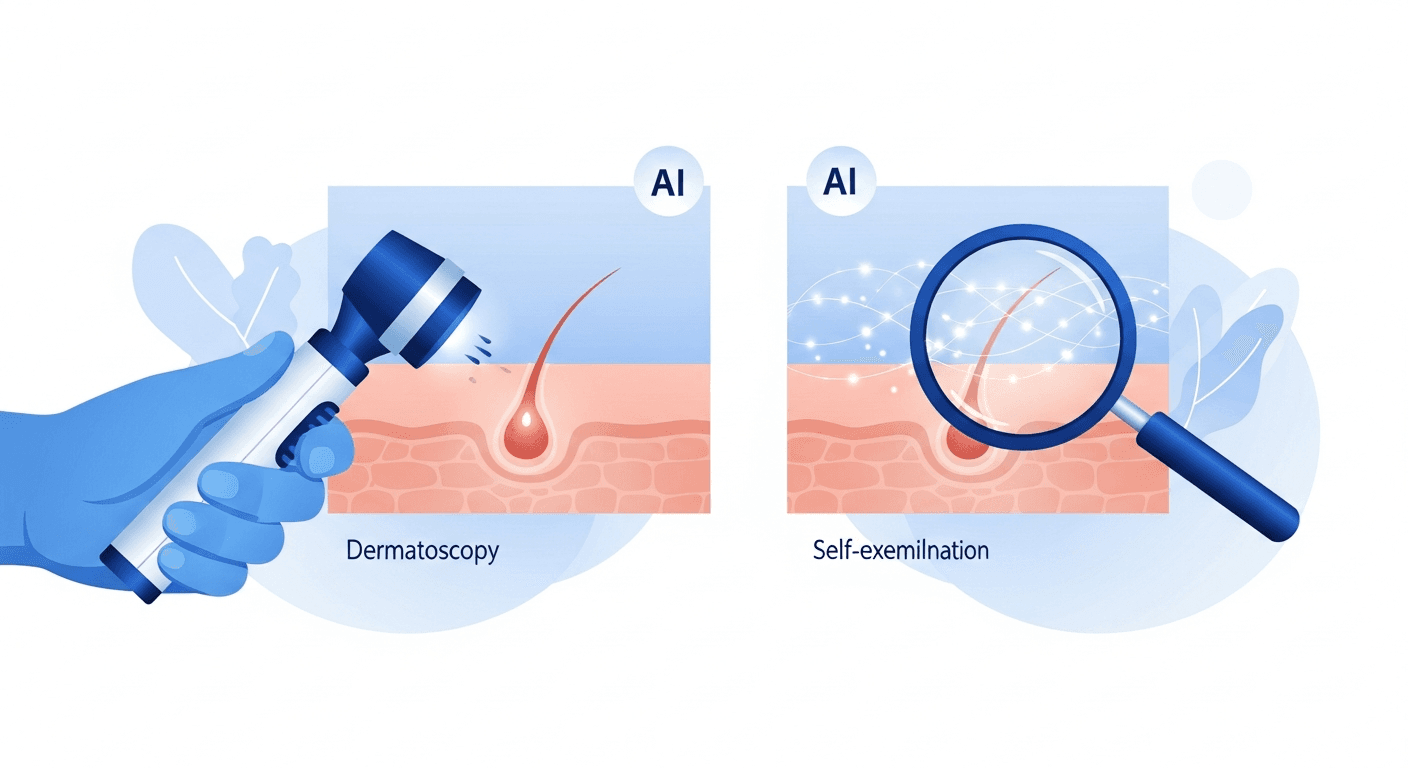
Dermoscopy, also known as epiluminescence microscopy, is an indispensable method in professional skin cancer early detection. In this non-invasive examination, the dermatologist examines suspicious skin changes with a special microscope. This instrument allows for a magnified and detailed view of skin structures that would not be visible to the naked eye. Deeper pigment patterns, vascular structures, and other morphological features can thus be assessed, significantly improving diagnostic accuracy.
The advantages of dermoscopy are manifold: It significantly improves diagnostic accuracy compared to naked-eye inspection and helps differentiate benign from malignant lesions, thereby avoiding unnecessary biopsies. In Germany, the costs for dermoscopic examination as part of cancer early detection are covered by statutory health insurance, underlining its establishment as a standard procedure. Despite its effectiveness, there are also limitations: The diagnostic quality largely depends on the experience and trained eye of the examining physician. Studies have shown that the diagnostic specificity of dermoscopy can be as low as 32%, leaving room for improvement. It is a valuable but subjective tool that can be complemented by more objective methods.
The Diagnostic Revolution: AI Technology in Focus
Artificial intelligence (AI) is rapidly transforming medical diagnostics, and dermatology is no exception. AI-powered systems promise to significantly increase the accuracy and efficiency of melanoma early detection, representing an exciting addition to traditional methods. Research in this area is dynamic and continuously yields new insights and applications.
Current Developments and Studies (2023-2026):
- In January 2024, the FDA (U.S. Food and Drug Administration) granted approval for DermaSensor, the first AI-powered, non-invasive diagnostic tool for skin cancer, including melanoma. It uses spectroscopic technology and showed a 96% sensitivity for all skin cancer types in the DERM-SUCCESS study, reducing the number of overlooked skin cancers by half.
- An EU project called iToBoS is working on a novel whole-body scanner linked to an AI diagnostic platform. This scanner aims to automatically examine the entire body in just six minutes and provide a risk assessment, reducing the burden on medical professionals and cutting down on unnecessary biopsies.
- Researchers at the University of Missouri are developing high-resolution AI models that analyze images of the entire skin surface and evaluate visual patterns. Individual models achieved accuracies of up to 88%, while combining three models boosted this to over 92%.
- A study from the German Cancer Research Center (May 2025) highlighted that explainable AI (XAI) not only increases diagnostic trust but can also improve the endurance of dermatologists in difficult cases by reducing cognitive load and thus minimizing potential sources of error.
These advances demonstrate that AI systems, when trained with large image datasets, can identify melanomas in photos as reliably and competently as trained dermatologists. They serve as powerful support that complements medical expertise and significantly increases diagnostic precision.
DermCheck: Your Intelligent Companion for Skin Care
Amidst these groundbreaking developments, DermCheck positions itself as your personal, intelligent companion for skin care. Our AI-powered app is designed to put the benefits of Artificial Intelligence directly into your hands and facilitate early detection. With DermCheck, you can easily and conveniently document and analyze skin changes from the comfort of your home. The app uses advanced algorithms, trained on vast datasets of skin images, to identify suspicious features according to the latest dermatological findings.
How DermCheck supports you:
- Easy Documentation: Capture photos of your moles and skin spots over time.
- AI Analysis: Our intelligent technology analyzes the images for abnormalities and changes that might correspond to the ABCDE rule or the "Ugly Duckling Sign."
- Progression Monitoring: DermCheck helps you track the evolution of skin changes – a crucial criterion for detecting melanomas.
- Actionable Recommendations: In case of potential risk indicators, the app provides a clear recommendation to consult a dermatologist.
DermCheck makes skin cancer early detection more accessible and offers a valuable initial assessment that empowers you to act proactively. It is a powerful tool that bridges the gap between self-observation and professional diagnosis, helping you detect changes early, before they become critical.
Learn more about how DermCheck works and how you can best protect your skin.
Innovation in Depth: Confocal Laser Microscopy (CLM)
While AI apps like DermCheck offer an excellent initial screening level, there are further innovative non-invasive methods in professional diagnostics that allow for deeper insight. One such method is Confocal Laser Microscopy (CLM), also known as Reflectance Confocal Microscopy (RCM). This procedure represents a true advance as it enables the generation of tissue-level images of the skin at a cellular level without the need for surgical removal. It is therefore also referred to as a "bloodless biopsy."
Functionality and Advantages: Using a diode laser, light pulses are sent into the skin. Their reflections are captured and processed into highly magnified horizontal cross-sectional images of the skin. This painless procedure provides real-time images of living tissue with cellular-level resolution (lateral resolution of 0.5-1.0 µm, axial resolution of 3-5 µm). This is particularly advantageous in visible areas like the face, where a biopsy would leave scars. CLM can significantly increase the diagnostic specificity in melanoma early detection. Studies show that it can more than double diagnostic specificity compared to dermoscopy, from 32% to an impressive 68%. This leads to benign nevi (moles) being correctly identified as such, thereby reducing unnecessary excisions. Although CLM is explicitly recommended in medical guidelines for the examination of suspicious pigmented lesions, it is currently available only in a few clinics and practices in Germany, highlighting its status as a highly specialized but not widely available procedure.
Framework: Medical Guidelines and Recommendations for Prevention
Skin cancer early detection is not only an individual responsibility but is also supported by national and international medical guidelines and recommendations. These provide physicians with evidence-based guidance for diagnosis and therapy and serve as an important framework for public health prevention.
- German Skin Cancer Screening: In Germany, statutorily insured individuals aged 35 and older can undergo a free skin cancer screening every two years. The goal is the early detection of white and black skin cancer to improve cure rates. Some health insurance companies also cover the costs for younger insured individuals (e.g., from age 18), emphasizing the importance of early prevention. The screening includes a physical examination of the entire skin by a specially trained physician (GP or dermatologist).
- American Academy of Dermatology (AAD) Guidelines: The AAD published updated guidelines for the management of primary cutaneous melanoma in March 2026. These emphasize that skin biopsy remains the first step for definitive diagnosis of cutaneous melanoma and surgery is the cornerstone of treatment. The guidelines also address aspects such as managing melanoma during pregnancy, genetic testing for hereditary risk, and managing dermatological side effects of new immunotherapies.
- U.S. Preventive Services Task Force (USPSTF): The USPSTF concluded in 2023 that there is insufficient evidence to recommend for or against visual skin examination by a clinician for skin cancer screening in asymptomatic adolescents and adults. This statement underscores the need for further research and the development of new, more objective, and accessible screening methods – precisely where AI-powered approaches like DermCheck step in to fill this gap.
Looking Ahead: New Treatment Methods and the Role of Research
While this blog post focuses on early detection, it is essential to know that melanoma treatment, especially in advanced stages, has also made enormous progress. Ongoing research and development in this field offer new hope to patients facing a melanoma diagnosis.
- Immunotherapies and Targeted Therapies: The AAD guidelines and numerous studies confirm that a better understanding of the molecular mechanisms of melanoma has led to revolutionary therapeutic options. Modern immunotherapies and targeted agents have significantly improved survival rates in metastatic melanoma. As mentioned earlier, the 5-year survival rate for Stage IV with modern immunotherapies is now approximately 40-50% – a significant increase compared to previous periods. These therapies leverage the body's own immune system or specifically target genetic mutations in tumor cells to combat cancer growth and spread.
- Continuous Research: The scientific community continues to focus intensively on developing even more precise diagnostic tools and more effective, personalized therapies. The integration of AI into early detection and treatment planning, as well as the use of non-invasive imaging techniques such as confocal laser microscopy, will play an increasingly important role. The goal is to find the best possible treatment for each patient based on their individual tumor characteristics and thus further improve the prognosis.
Conclusion: Your Skin, Your Health – Together for Optimal Prevention
The early detection of malignant melanoma is a complex and vital field, ranging from individual responsibility to highly modern technological approaches. Regular self-skin examination following the ABCDE rule and the "Ugly Duckling Sign" remains a fundamental and accessible pillar of personal prevention. Professional dermoscopy by experienced dermatologists continues to be an indispensable tool in practice, gaining precision and efficiency through the introduction of AI-powered diagnostic systems and non-invasive imaging techniques like confocal laser microscopy.
Innovative solutions such as DermCheck empower you to take control of your skin health by providing an intelligent tool for monitoring progression and initial assessment. These new technologies promise not only improved detection but also a reduction in unnecessary interventions. At the same time, we must not underestimate the importance of preventive measures, especially consistent UV protection. By consistently utilizing the various pillars of early detection and prevention, we can collectively help reduce the burden of malignant melanoma and optimize the chances of recovery for those affected.
Important Note: AI systems like DermCheck are valuable support tools for early detection and monitoring. However, they are in no way a substitute for personal diagnosis, treatment, or regular screening examinations by a qualified dermatologist. In case of abnormalities, a specialist should always be consulted who can provide a definitive medical assessment and initiate further steps.
Stay healthy and protect your skin!